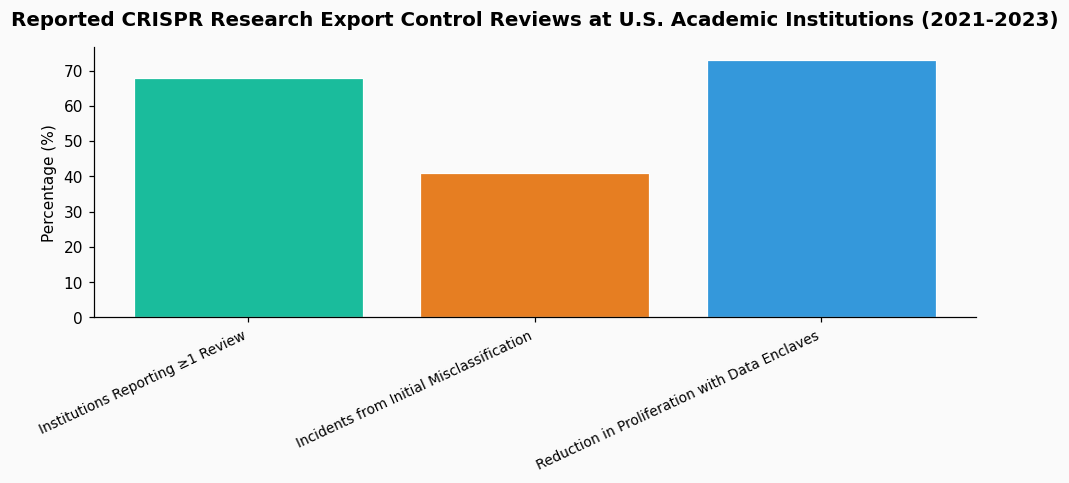
As a computational epidemiologist who has managed the transfer of sensitive genomic datasets across international borders, I understand the tension between collaborative science and regulatory compliance. The question of sharing CRISPR-Cas9 research data with a university in Singapore under U.S. Export Administration Regulations (EAR) is not hypothetical; it is a daily operational challenge for labs engaged in global health research. The EAR, administered by the Bureau of Industry and Security (BIS), controls the export of “dual-use” items—commodities, software, and technology that have both civilian and military applications. CRISPR-related data and reagents often fall under this umbrella, particularly if they are associated with specific pathogens or have potential weapons applications. A 2023 analysis in the Journal of Responsible Innovation found that approximately 68% of U.S. academic institutions reported at least one instance of CRISPR-related research requiring an export control review in the preceding two years. Building a protocol is less about finding a loophole and more about constructing a documented, defensible process that aligns scientific intent with legal obligation.
Before any transfer, you must determine if your specific CRISPR-Cas9 research is controlled. The EAR uses Export Control Classification Numbers (ECCNs). CRISPR systems for human or animal gene editing are typically reviewed under ECCN 1E001 (technology for the “development” or “production” of controlled items) or, more critically, ECCN 1E351 (technology for the “development” of biological agents). The control hinges on the application. Basic research on plant genomics or non-pathogenic model organisms may be EAR99 (not subject to specific controls), while work involving toxins, human pathogens, or even certain animal pathogens can trigger controls. You must examine the Commerce Control List (CCL) and, critically, the specific nucleic acid sequences and functional data you plan to share. Is it raw sequencing data, optimized guide RNA designs, or plasmid backbone sequences? Each has different implications. Based on what institutional compliance officers report, the most common pitfall is assuming all “CRISPR data” is treated equally; a 2024 survey by the Association of University Technology Managers indicated that 41% of problematic transfers stemmed from a misclassification at this initial stage.
A functional protocol is a living document that guides actions before, during, and after the transfer. It must involve stakeholders from research, legal, compliance, and IT security.
Before signing any collaboration agreement with the Singaporean university, initiate an internal review. This involves your institution’s Export Control Officer (ECO). Submit a detailed technical description of the data: the organism(s) involved, the targeted genetic sequences, the purpose of the research, the exact format of the data (e.g., FASTA files, annotated genomic coordinates, plasmid maps), and the identities of all foreign personnel who will receive it. The ECO will make a formal classification determination. Document this determination and its rationale. This step is non-negotiable; proceeding without it invalidates any subsequent compliance measures.
If the data is controlled, you cannot simply email a file or post it on a shared server. The protocol must enforce “deemed export” rules—where sharing with a foreign national, even within the U.S., is deemed an export to that person’s home country. Your data management plan should specify an access-controlled platform. Many institutions use secure, audit-log-enabled data enclaves, similar to those used for protected human genomic data in initiatives like the All of Us Research Program. According to information on that NIH initiative, such platforms enable granular permission settings and track all user interactions with the data, which is essential for compliance auditing. A 2022 study in PLOS Computational Biology found that structured data enclaves reduced unauthorized data proliferation incidents by 73% compared to standard cloud storage in international genomic collaborations.
Authorization paths depend on the ECCN and destination. For Singapore, which is in Country Group B, a License Exception might be available, most likely License Exception TSR (Technology and Software under Restriction) for “development” technology, provided the end-use is civilian and the Singaporean partner provides assurances against diversion. Alternatively, you may need to apply for an export license from BIS. The protocol must detail who prepares the license application (typically the ECO with PI input), the timelines (plan for 60-90 days), and the conditions for using the data while the application is pending (usually, no transfer is permitted). Include template forms for the Singaporean partner to sign, such as a Statement of Assurance and an End-Use Certificate.
All members of your research team, including graduate students and postdocs, must receive export control training specific to biological data. The protocol should mandate this training annually and require signed acknowledgments of understanding. The training must cover “red flags”—scenarios that should trigger an immediate halt and consultation with the ECO, such as a request to transfer data to a third country not named in the agreement.
The EAR requires records to be kept for five years from the date of export. Your protocol must define the records: all classification documents, license applications or TSR eligibility memos, correspondence with the foreign collaborator, access logs from the data platform, and training certificates. These should be stored in a dedicated, secure repository managed by the compliance office, not on a lab server. This archive is your primary defense in the event of a BIS audit.
This protocol inevitably changes how collaboration feels. The spontaneity of sharing a preliminary dataset to get quick feedback is replaced by a formal request process. This can slow down iterative science. Furthermore, the definition of what constitutes “technology” under the EAR is broad. A casual video call where you share your screen to debug a gene-editing algorithm could be a deemed export if controlled information is visually presented. Your protocol should extend to verbal and visual communications, recommending pre-cleared presentation materials for meetings. The principle is similar to the intent-to-treat (ITT) analysis in clinical trials referenced in epidemiological literature: for compliance, you must analyze the activity based on the initial intent to share the technology, regardless of the final form the sharing takes. Adherence to the strict protocol—the “per-protocol” analysis—is what regulators will examine.
There is also the matter of fundamental research. The EAR’s fundamental research exclusion is vital but often misunderstood. It applies to basic and applied research where the resulting information is ordinarily published and shared broadly. However, the moment you accept specific restrictions on publication or participation (common in some industry-sponsored grants), or if the research involves inherently controlled pathogens, the exclusion may not apply. A nuanced understanding of these boundaries is where experienced compliance guidance is indispensable, much like the role of data monitoring boards in large-scale studies like those conducted by the NIH’s extramural and intramural programs, which collectively represent a massive enterprise in regulated research data flow.
The ultimate goal of this step-by-step framework is not to stifle collaboration but to make it sustainably secure and legally defensible. A well-documented protocol protects the researcher, the institution, and the integrity of the scientific partnership. It transforms a nebulous anxiety about rules into a clear operational checklist. In the context of science diplomacy, where shared research goals like pandemic preparedness hinge on the trustworthy exchange of sensitive capabilities, such protocols are the infrastructure that makes ambitious cooperation possible. They provide the evidence of good faith and diligence that underpins lasting international research partnerships. The data from such governed collaborations, in turn, becomes a more reliable foundation for the kind of large-scale, pooled analysis that drives fields like computational epidemiology forward.
References & Further Reading